
Morgan County Court Records After a Jail Arrest
Once a person is arrested and booked in Morgan County, the case is not yet a court record. The arresting agency lists a charge, but the prosecutor, the Morgan County State's Attorney, decides what to actually file. When charges are filed in the Morgan County Circuit Court, a case opens, and that case becomes the court record. The Circuit Clerk is the official keeper of those records and the court seal under Illinois law, which is why the clerk's systems, not the jail, hold the charge history after an arrest.
It helps to keep the two sides apart. The booking and custody side, including the roster and booking detail, is covered on the jail inmate records page, and booking photos sit on the jail mugshots page. This page is about the court record that follows an arrest: the charges the prosecutor filed, the documents that started the case, and how that case moves through the system.
How to Find Morgan County Court Records After an Arrest
The Morgan County Circuit Clerk links an online case search called Judici, along with a Plea and Pay tool. Judici is where charges and charge status show up once a case is filed, while the arrest and booking detail stays with the jail. A direct automated visit to Judici hits a human-verification step, so use the clerk's official link as a person rather than expecting a scripted lookup.
- Open the Morgan County Circuit Clerk page and follow its Judici case search link.
- Search by the defendant's name, or by case number if you already have one.
- Open the criminal case and read the list of charges the prosecutor filed.
- Check each charge's class, count, and current status, and compare it to the original arrest charge.
You can reach the case search through the Morgan County Circuit Clerk page, shown in the screenshot below.
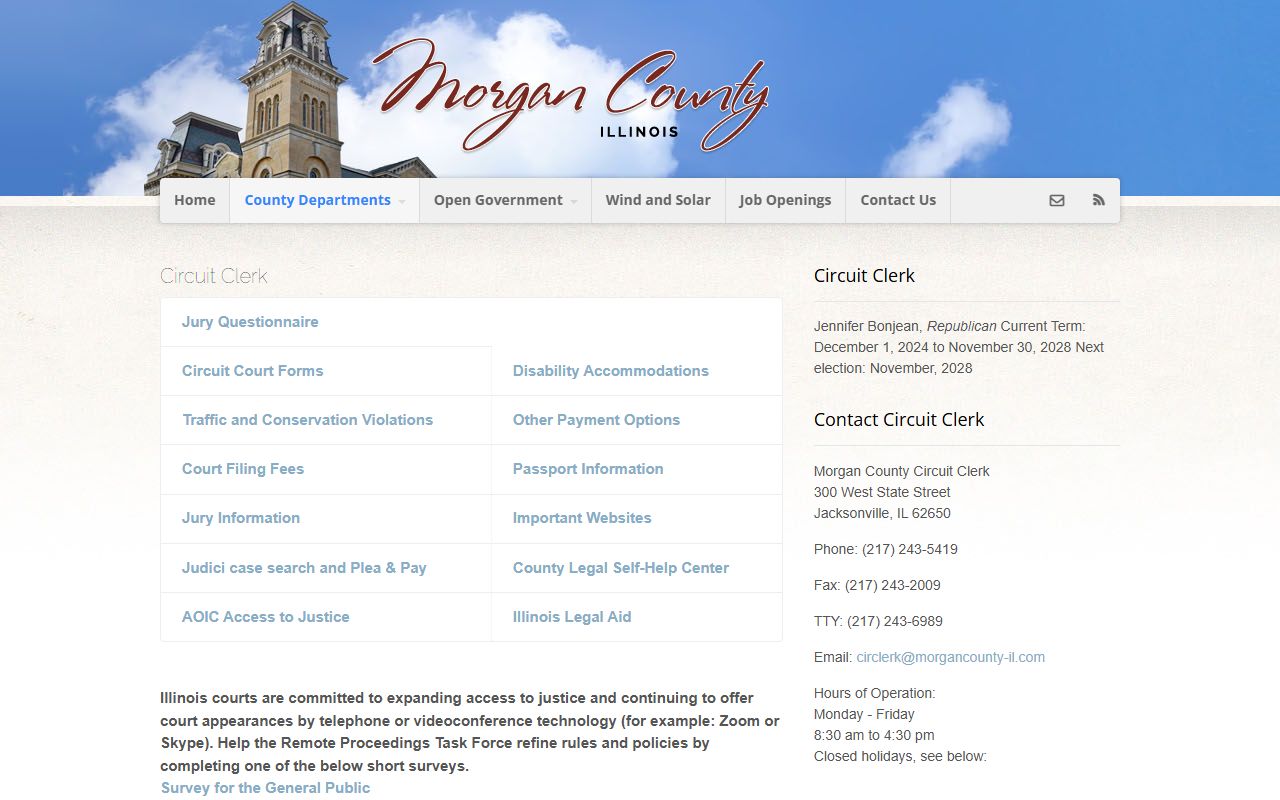
The same page links Odyssey eFile Illinois, the system Morgan County uses for electronic filing in civil and criminal cases, which is why a docket can show activity even when you still need the clerk for certified copies.
The online docket is a public access route, but the official file stays with the Circuit Clerk, who is the statutory keeper of the Morgan County Circuit Court records and seal. For a certified copy or a record that is not visible online, the clerk's office is the source. Statewide court resources, including pretrial-process information, are published by the Office of the Illinois Courts, which is useful background when a county docket alone does not answer the question.
How Charges Get Filed After an Arrest: Complaint, Information, and Indictment
The court record opens with a charging document. After booking, the prosecutor decides whether to charge and which form to use. A complaint is common early in a case. An information is a prosecutor-filed formal charge used in many felony and misdemeanor cases. An indictment comes from a grand jury for some serious felonies. Each one starts the case, but they reach that point by different routes.
| Complaint | Information | Indictment | |
|---|---|---|---|
| Filed By | Officer or prosecutor | Prosecutor (State's Attorney) | Grand jury |
| Common For | Early-stage and misdemeanor cases | Many felonies | Serious felonies |
| Starts | The case | The case | The case |
The Morgan County State's Attorney, Gray H. Noll, leads the office that makes these decisions and also runs victim and witness services. You can read about that office on the Morgan County State's Attorney page, pictured below.
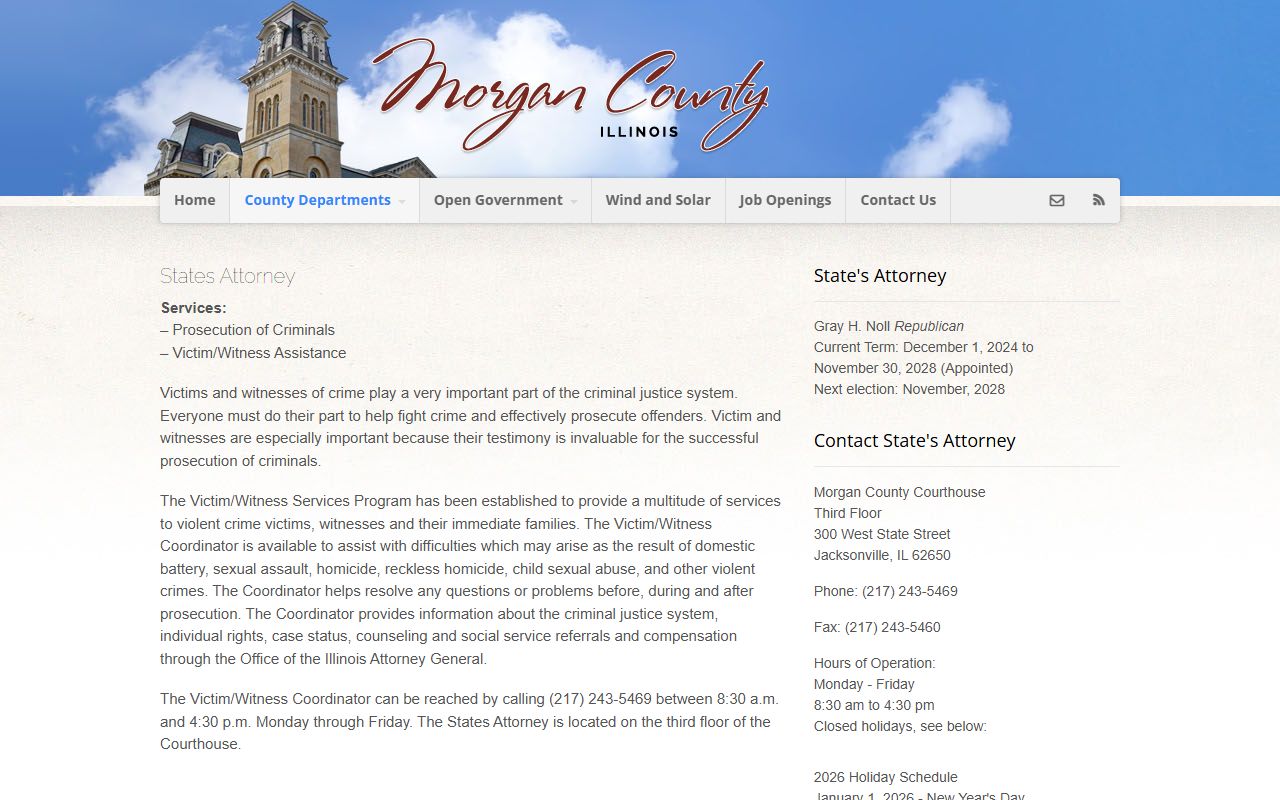
The page describes prosecution and a victim and witness program that helps people before, during, and after a case, which matters because the charges the office files can differ from the arrest charge.
For crime victims trying to follow a case after an arrest, the State's Attorney's victim and witness coordinator is an official support path, reachable at (217) 243-5469 on weekdays. The coordinator helps with case status and the criminal-justice process, though that office is not a general inmate locator. It is the right contact for staying informed about a prosecution rather than for confirming day-to-day custody.
Charge Status in Court Records After an Arrest
Charges are not fixed once they are filed. As a case moves, a charge can be amended, reduced, added, or dropped. The booking charge from the night of the arrest may not match the final filed charge at all, because the prosecutor reviews the case before and after filing. The terms below are the ones you will see on a Morgan County case.
| Status | What It Means |
|---|---|
| Pending | The case or charge is still open and has not been resolved |
| Amended or Reduced | The charge was changed or replaced with a lesser offense by a later filing |
| Dismissed | The charge ended without a conviction |
| Nolle Prosequi | The prosecutor chose not to go forward on that charge |
Note: a same-day search can come up empty simply because filing and indexing have not caught up with the arrest yet.
Bond and Release After an Arrest
Illinois changed how release works. Since September 18, 2023, the state no longer uses cash bail as a condition of pretrial release. After booking, a case moves toward a first appearance, where a judge decides release conditions, or, if the prosecutor petitions for it and meets the legal standard, orders the person detained. So a newly arrested person in Morgan County is not simply waiting for someone to post a dollar amount.
| Term | How It Works in Illinois Now |
|---|---|
| Cash bail | No longer used as a new condition of pretrial release |
| Pretrial release | The default; a judge sets conditions rather than a release price |
| Pretrial detention | The prosecutor must petition, and the judge decides under statutory standards |
| Conditions of release | Nonfinancial rules such as appearance, no-contact, supervision, or monitoring |
| Holds and detainers | A separate hold can keep someone in custody even when the local case would allow release |
To check current release status, call the Morgan County Jail at (217) 243-6123, and use the Circuit Clerk and Judici for the court side of the case.
Warrants That Lead to an Arrest
Morgan County does not publish an official online warrant list or most-wanted page, so warrant lookups are a contact-and-court process. An arrest warrant authorizes arrest for a new matter, while a bench warrant is issued by a judge, often for a missed court date. A search warrant authorizes a search and is not a custody order. When a warrant is served, the person is booked, the jail checks for added holds, and a court hearing follows if the warrant ties to a Morgan County case.
To check on a possible warrant, the safest routes are the Circuit Clerk and the court docket, where bench-warrant activity can appear after a case exists, or a call to the sheriff at (217) 243-6123. Warrant information is high stakes, so verify it with the issuing court rather than any third-party site, and consider speaking with an attorney before acting on it.
Charges vs. Convictions
An arrest and a filed charge are accusations, not proof of guilt. A conviction is a separate stage that requires a plea or a verdict. Treating a charge as a conviction is both wrong and, in some uses, unlawful.
| Charge | Conviction | |
|---|---|---|
| Stage | Accusation | Verdict or plea |
| Burden of Proof | Probable cause | Beyond a reasonable doubt |
| Public Record | Yes | Yes |
Sealed vs. Expunged Arrest Records
Illinois lets some people seal or expunge records after a dismissal or an eligible outcome. Sealing hides a record from most public view while leaving limited law-enforcement access. Expungement goes further, removing the record so it is treated as if it never existed. Eligibility is set by Illinois law and depends on the charge and disposition, so the court is the place to confirm what applies.
| Sealed | Expunged | |
|---|---|---|
| Visibility | Hidden from most public access | Removed and treated as never existing |
| Law Enforcement | Limited access remains | Very limited access |
| Eligibility | Set by Illinois statute and case outcome | Set by Illinois statute and case outcome |
Background Check Considerations
A casual court-record lookup is not the same as a regulated background check. Formal checks used for hiring, housing, credit, or insurance fall under the federal Fair Credit Reporting Act and must come from a compliant consumer reporting agency. A free public case search does not meet that standard and was never meant to.
Important: This site is a public reference, not an FCRA-regulated consumer reporting agency, so nothing here may be used to make credit, employment, housing, or insurance decisions.
Restricted Court Records After an Arrest in Morgan County
Not every court record after an arrest is open. Juvenile law-enforcement records that have not been expunged are confidential under Illinois law and are not made available to the general public. Sealed or expunged cases may not appear in public systems at all. A newly filed case may not be indexed yet, and active-investigation material can be withheld. When an online search comes up short for one of these reasons, the Circuit Clerk is the office to confirm whether a record exists and what can be released.